PM Shehbaz, Field Marshal Asim Munir speak to Pakistani astronaut Zeeshan Ali aboard Chinese space station

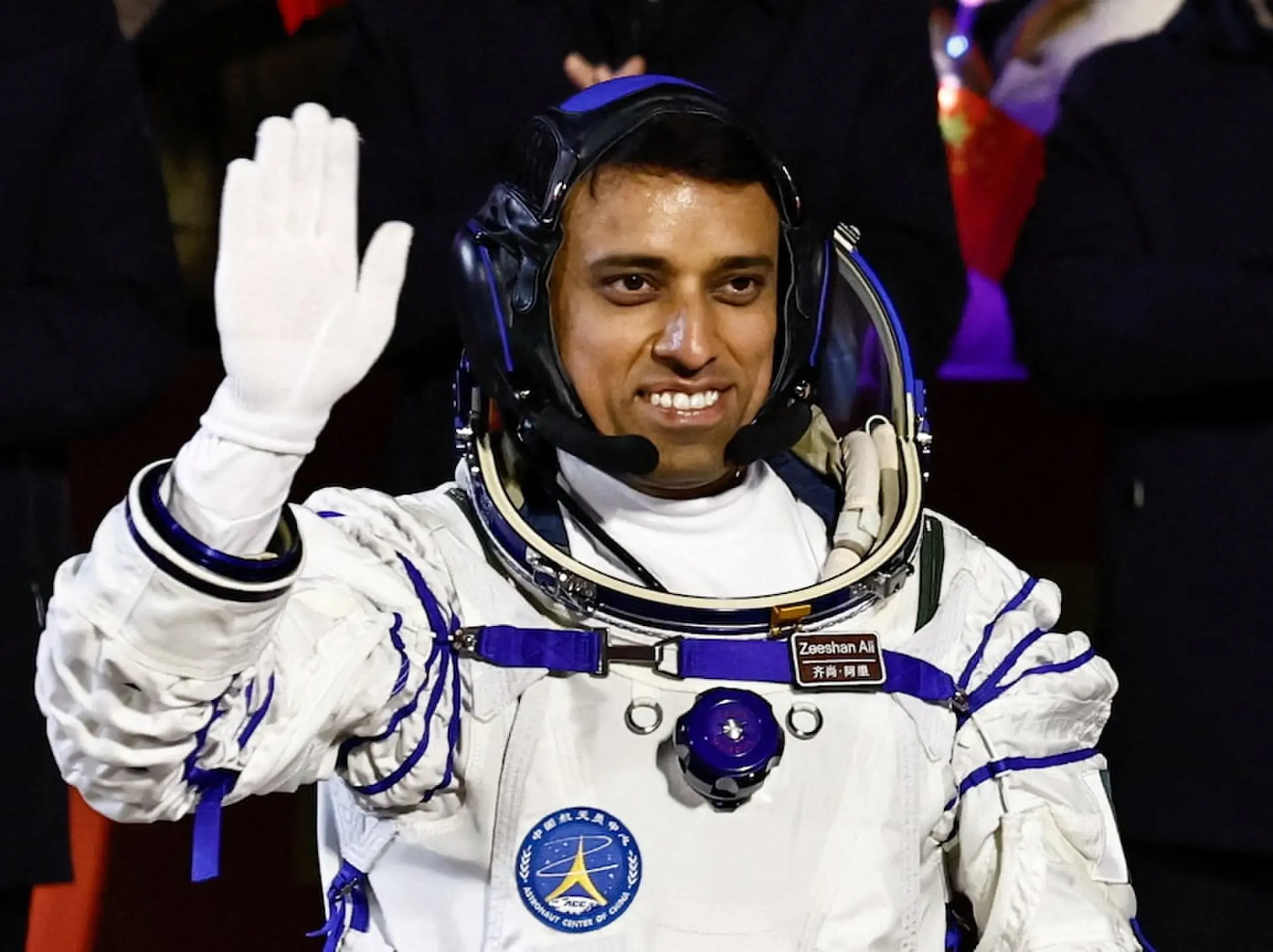

Prime Minister Shehbaz Sharif and Field Marshal Syed Asim Munir held a video call on Saturday with Wing Commander Muhammad Zeeshan Ali, the first Pakistani astronaut to enter Earth’s orbit, currently aboard China’s Tiangong space station, Chinese media reported.
The conversation comes three days after Ali embarked on his historic journey into space as part of China’s Shenzhou-24 mission, becoming the first foreign astronaut to board the Chinese space station.
The mission marks a significant milestone in Pakistan’s space programme and opens a new chapter in its longstanding scientific and technological cooperation with China.
Details of the conversation have yet to be made public.
Pakistan’s historic journey into orbit
The video call comes three days after Ali made history as the first Pakistani astronaut to enter Earth’s orbit, becoming the first foreign astronaut to board China’s Tiangong space station.
The Shenzhou-24 spacecraft lifted off from the Jiuquan Satellite Launch Centre in northwestern China at 5:18am Pakistan time on Wednesday, carrying Ali alongside Chinese astronauts Tang Hongbo and Wu Yi.
The spacecraft subsequently docked with the Tiangong space station, where the three astronauts joined the crew already stationed aboard the orbiting laboratory.
A 40-year-old Pakistan Air Force (PAF) fighter pilot, Ali underwent months of specialised training in China, including preparations for emergency procedures, survival exercises and adapting to conditions in space.
Ahead of his departure, Ali had spoken about carrying the hopes of 250 million Pakistanis, describing the mission as a historic opportunity for his country.
During his stay aboard the space station, Ali is expected to participate in scientific experiments under the joint Pakistan-China space programme.
Pakistan-China friendship extends into space
Pakistan and China signed an astronaut cooperation agreement in February 2025, paving the way for the selection and training of Pakistani astronauts for a mission aboard Tiangong.
Ali and fellow Pakistani pilot Khurram Daud were subsequently selected to undergo specialised training at the China Astronaut Research and Training Centre in Beijing.
Following Wednesday’s successful launch, President Asif Ali Zardari and Chinese President Xi Jinping exchanged congratulatory messages, while Pakistan’s civilian and military leadership hailed the achievement.
On Thursday, Prime Minister Shehbaz received Chinese Ambassador Jiang Zaidong in Islamabad, congratulating the Chinese leadership and people on the successful mission.
Pakistan’s military leadership also described Ali’s journey as a significant milestone in the country’s scientific and technological advancement, saying the friendship between Pakistan and China had extended beyond Earth’s frontiers.
You May Also Like
CDA seals Fazlur Rehman’s Islamabad residence after cancelling property’s transfer
From commitments to action: Makkah defence talks enter second day in Islamabad

Karachi building collapse: Two more bodies pulled from rubble as death toll climbs to 11
54 hours under rubble: Karachi building collapse survivor rescued alive
Makkah pact allies pledge intensified efforts for Saudi security amid Houthi attacks
Bilawal backs South Punjab province despite opposing division of Sindh
Karachi building collapse death toll rises to eight as rescue operation enters third day

Islamabad community dialogue highlights barriers to reporting violence against women
Pakistan showcases homegrown nuclear security technology to IAEA, international delegates

No independent verification of reported Libya boat tragedy involving Pakistanis: FO