Makkah pact allies pledge intensified efforts for Saudi security amid Houthi attacks

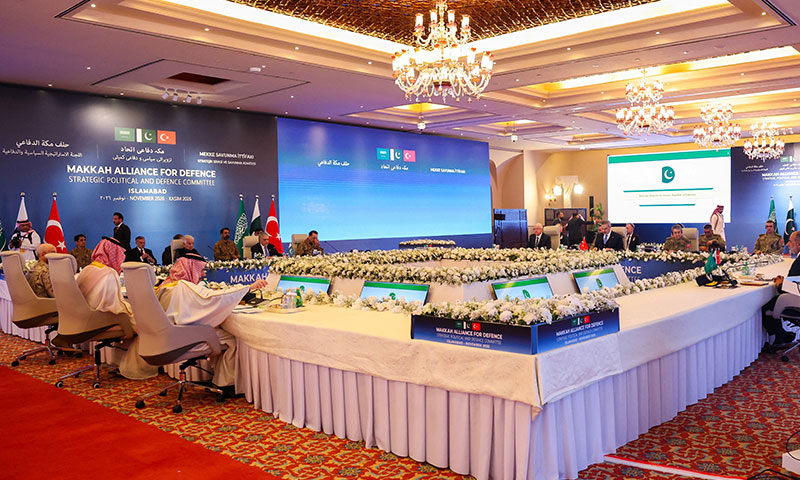

ISLAMABAD: Pakistan and Turkiye pledged to intensify efforts to safeguard Saudi Arabia’s security amid continued Houthi attacks, reaffirming their commitment to collective defence under the Makkah Joint Defence Agreement (MJDA) following high-level talks in Islamabad on Friday.
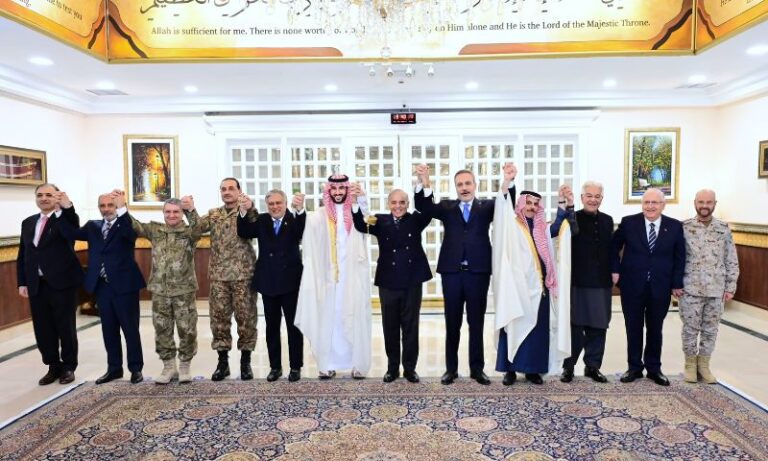
The commitment was announced following the second meeting of the Strategic Political and Defence Committee (S-PDC) of the Makkah Alliance for Defence, which brought together foreign and defence ministers and senior military officials from the three countries.
The meeting reviewed the evolving regional security situation and reaffirmed the three countries’ determination to work collectively towards regional peace, security and stability.
Addressing a press briefing after the meeting, Deputy Prime Minister and Foreign Minister Ishaq Dar said he, along with Defence Minister Khawaja Asif and Chief of Defence Forces (CDF) and Chief of Army Staff (COAS) Field Marshal Syed Asim Munir, represented Pakistan at the talks.
Dar said the participants had reviewed progress on decisions taken at previous meetings and expressed satisfaction over the progress towards establishing and operationalising the alliance’s secretariat in Saudi Arabia.
The three sides also agreed to continue consultations on matters of mutual interest, support efforts to de-escalate regional tensions and encourage the peaceful resolution of disputes through dialogue and diplomacy.
Houthi attacks on Saudi Arabia condemned
A key outcome of the meeting was the three countries’ strong condemnation of Houthi attacks targeting civilians and civilian infrastructure in Saudi Arabia.
In a joint statement issued after the meeting, the three countries condemned “persistent and heinous attacks” by the Houthi militia against the kingdom.
They reaffirmed their collective resolve to “continue exerting and accelerating efforts” to support Saudi Arabia in safeguarding its security in accordance with the collective defence provisions of the agreement.
The statement also reiterated the three countries’ commitment to strengthening cooperation in defence industries, joint technological development, training and capacity-building to enhance the collective capabilities and cohesion of their armed forces.
PM pledges full support for Saudi security
Prime Minister Shehbaz Sharif reaffirmed Pakistan’s strong commitment to the Makkah defence alliance, welcoming the unity and determination of Pakistan, Saudi Arabia and Turkiye to defend their security, sovereignty and territorial integrity in accordance with the agreement.
On the sidelines of the meeting, high-level delegations from Saudi Arabia and Turkiye called on the prime minister in Islamabad.
The Saudi delegation comprised Defence Minister Prince Khalid bin Salman bin Abdulaziz Al Saud, Foreign Minister Prince Faisal bin Farhan Al Saud and Chief of the General Staff General Fayyadh bin Hamed Al-Ruwaili.
The Turkish delegation included Foreign Minister Hakan Fidan, National Defence Minister Yasar Guler and Chief of the General Staff General Selcuk Bayraktaroglu.
The premier expressed satisfaction over the outcome of the second S-PDC meeting and reaffirmed Pakistan’s unwavering solidarity with Saudi Arabia, assuring the kingdom of full support for its sovereignty, territorial integrity and security.
The three sides also exchanged views on the latest regional developments and expressed their resolve to continue working together for lasting peace and stability in the region.
The Pakistani delegation included DPM Dar, CDF Munir, Defence Minister Asif and National Security Adviser Lieutenant General Muhammad Asim Malik.
Makkah defence pact moves towards implementation
The Islamabad meeting marked another step towards translating commitments made under the Makkah defence pact into practical arrangements for cooperation among the three countries.
Pakistan, Saudi Arabia and Turkiye signed the agreement on August 7, pledging that an armed attack against any member would be treated as an attack against all three, with assistance to be provided through available means, including military support.
The agreement established a framework for collective defence and closer security cooperation among the three countries, with subsequent meetings focusing on developing institutional mechanisms and practical arrangements to implement its commitments.
At the inaugural meeting of the Strategic Political and Defence Committee in Istanbul on August 31, the three countries agreed to further institutionalise their cooperation to strengthen collective deterrence and defence.
The meeting brought together foreign and defence ministers, as well as chiefs of defence forces and chiefs of general staff from the three countries.
The participants agreed to establish a permanent secretariat in Saudi Arabia, headed by a secretary-general, with Pakistan initially providing the officeholder for a three-year term.
The Istanbul meeting also outlined cooperation in strengthening defence capabilities and the cohesion of the three countries’ armed forces through joint activities, defence industry cooperation, joint technology development and production.
The committee subsequently convened an emergency meeting in Riyadh on October 5 to discuss security developments and threats facing Saudi Arabia.
During the meeting, the committee appointed Pakistan’s retired Lieutenant General Nauman Mahmood as the alliance’s first secretary-general for a three-year term.
The participants also decided to move towards the practical implementation of collective defence commitments, including arrangements for the deployment of agreed military forces and capabilities in Saudi Arabia, subject to approved arrangements and the national laws of the three countries.
The committee also condemned attempts to target Makkah and Madina, as well as attacks on Saudi cities and civilian and economic facilities, reaffirming the three countries’ commitment to collective defence.
Asif calls for faster pact implementation
Defence Minister Khawaja Asif had described the pact as being at a “nascent stage”, emphasising the need for frequent meetings to establish its framework.
Speaking to AFP on Thursday, ahead of the Islamabad meeting, Asif said the continuing instability south of Saudi Arabia would be an important item on the agenda. He also confirmed that foreign and defence ministers from all three countries would attend the meeting.
“The continuous turmoil south of Saudi Arabia will obviously be one agenda point in the meeting and it is very important,” he told AFP.
The minister also stressed the collective defence obligations under the agreement.
“Any threat to Saudi Arabia is a threat to Pakistan and Turkiye according to the pact, which is absolutely clear,” Asif said.
“Initially we need to have frequent meetings to steer what is being formulated, in a way that in the next couple of months we have everything in place so that we can move forward,” he added.
The two-day committee meeting was due to continue tomorrow (Saturday), as the three countries worked towards establishing more concrete arrangements for defence and security cooperation under the Makkah pact.
The discussions took place against the backdrop of heightened regional tensions, particularly renewed attacks involving Saudi Arabia and Yemen’s Houthi movement.
The Houthis, who control the Yemeni capital Sanaa and large parts of northern Yemen, have carried out attacks against Saudi territory, raising security concerns for the kingdom.
You May Also Like
CDA seals Fazlur Rehman’s Islamabad residence after cancelling property’s transfer
PM Shehbaz, Field Marshal Asim Munir speak to Pakistani astronaut Zeeshan Ali aboard Chinese space station
From commitments to action: Makkah defence talks enter second day in Islamabad

Karachi building collapse: Two more bodies pulled from rubble as death toll climbs to 11
54 hours under rubble: Karachi building collapse survivor rescued alive
Bilawal backs South Punjab province despite opposing division of Sindh
Karachi building collapse death toll rises to eight as rescue operation enters third day

Islamabad community dialogue highlights barriers to reporting violence against women
Pakistan showcases homegrown nuclear security technology to IAEA, international delegates
No independent verification of reported Libya boat tragedy involving Pakistanis: FO